

Ready to Build Your AI-Powered App?
If you’re looking to transform your idea into a powerful AI-driven product, now is the time to act. Whether you need a custom AI app, chatbot, or voice assistant integration, Oscalet has the expertise to bring your vision to life.
Book a free consultation today
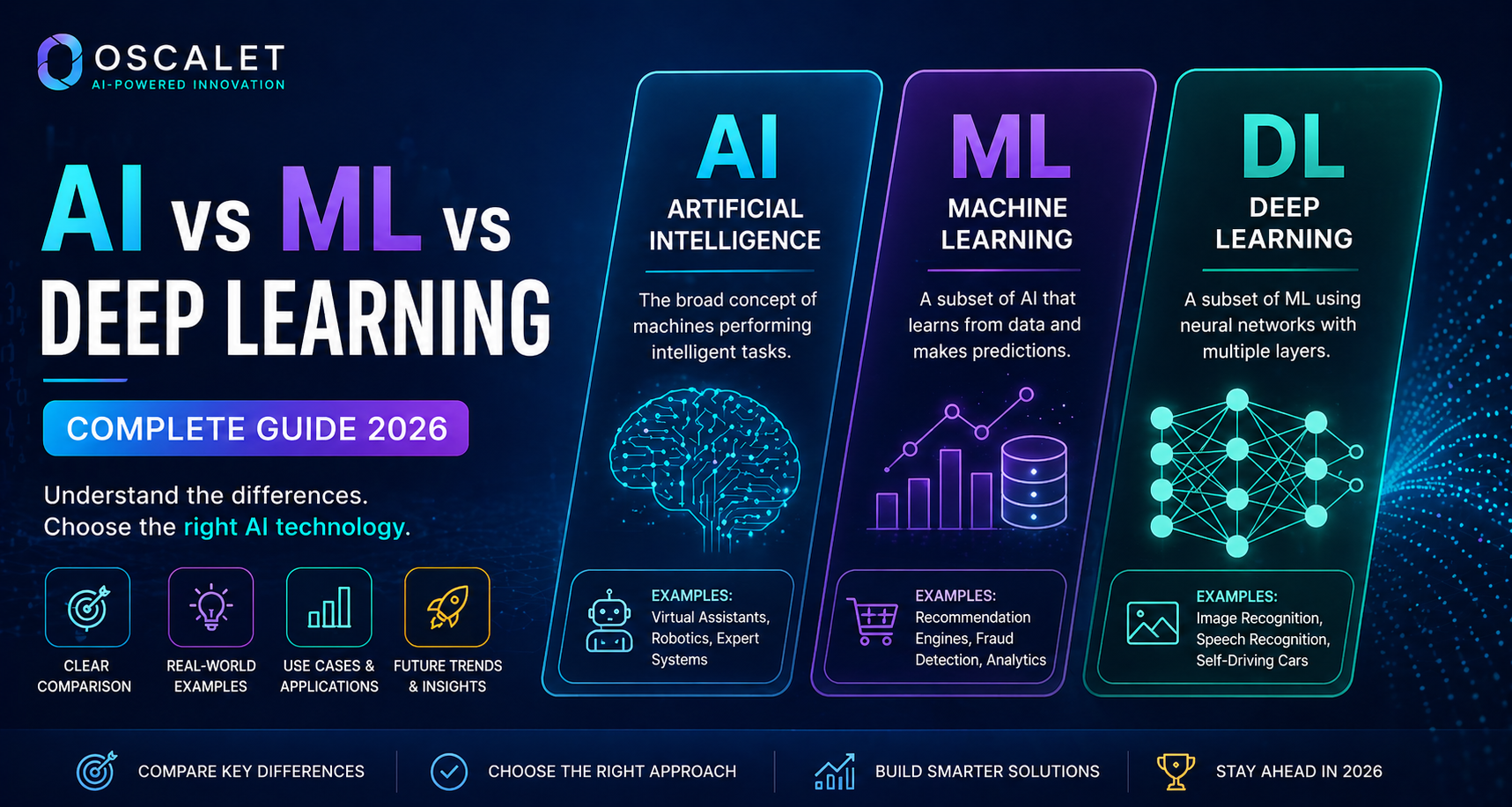
Summary:
AI vs ML vs Deep Learning explains how artificial intelligence is the broader concept, machine learning enables data-driven predictions, and deep learning uses neural networks to solve complex tasks, helping businesses choose the right AI technology for scalable and high-performance applications.
Introduction
Artificial intelligence, machine learning, and deep learning are often used interchangeably, but they represent different layers of intelligence within modern technology systems. Understanding their differences is essential for businesses and developers who want to build scalable and effective AI solutions.
This guide explains each concept in detail, highlights their differences, and helps you decide which approach is right for your use case.
What is Artificial Intelligence
Artificial intelligence is the broadest field that focuses on creating machines capable of performing tasks that typically require human intelligence. These tasks include reasoning, decision-making, problem-solving, and automation.
AI can be rule-based or learning-based and includes everything from simple automation systems to advanced intelligent platforms.
What is Machine Learning
Machine learning is a subset of artificial intelligence that enables systems to learn from data instead of being explicitly programmed.
Machine learning models analyze historical data, identify patterns, and make predictions. Over time, these systems improve their performance as they process more data.
What is Deep Learning
Deep learning is a subset of machine learning that uses neural networks with multiple layers to process complex and unstructured data.
It is particularly effective for tasks such as image recognition, speech processing, and natural language understanding. However, it requires large datasets and significant computational power.
Relationship Between AI, ML, and Deep Learning
Artificial intelligence is the overall concept of intelligent machines. Machine learning is a method used within AI to enable learning from data. Deep learning is an advanced technique within machine learning that focuses on neural networks.
In simple terms, AI is the goal, machine learning is the approach, and deep learning is the advanced implementation.
AI vs ML vs Deep Learning Comparison Table
| Feature | Artificial Intelligence (AI) | Machine Learning (ML) | Deep Learning (DL) |
| Definition | Broad concept of machines performing intelligent tasks | Subset of AI that learns from data | Subset of ML using neural networks |
| Scope | Very wide | Moderate | Narrow but deep |
| Data Requirement | Low to high | Medium to high | Very high |
| Complexity | Low to high | Medium | Very high |
| Learning Capability | Optional | Required | Advanced learning |
| Performance | Depends on system | High for structured data | Very high for complex data |
| Human Intervention | High in rule-based systems | Moderate | Low after training |
| Use Cases | Automation, robotics, assistants | Prediction, analytics | Image, speech, NLP |
| Examples | Rule-based chatbot | Recommendation engine | Facial recognition system |
| Development Cost | Low to high | Medium | High |
Key Differences Explained
Scope and Definition
Artificial intelligence covers all intelligent systems, including those that do not learn from data. Machine learning focuses specifically on data-driven learning, while deep learning is a specialized approach using neural networks.
Data Dependency
AI systems can operate with or without large datasets. Machine learning requires structured data to train models. Deep learning depends on large volumes of data to deliver high accuracy.
Complexity
AI can be simple or complex depending on the implementation. Machine learning introduces moderate complexity, while deep learning involves highly complex architectures and computations.
Performance
Deep learning provides the highest accuracy for complex problems such as image and speech recognition. Machine learning works well for structured data problems, while AI includes both simple and advanced systems.
Real-World Examples
Artificial intelligence can be seen in rule-based automation systems that follow predefined logic.
Machine learning is used in recommendation engines that suggest products based on user behavior.
Deep learning powers advanced systems such as facial recognition, voice assistants, and self-driving vehicles.
Use Cases of AI, ML, and Deep Learning
Artificial intelligence is used in automation systems, robotics, and intelligent assistants.
Machine learning is applied in predictive analytics, fraud detection, and customer insights.
Deep learning is used in computer vision, speech recognition, and natural language processing applications.
When to Use AI vs ML vs Deep Learning
Artificial intelligence should be used when the goal is automation or rule-based decision-making.
Machine learning is ideal when businesses have structured data and need predictions or insights.
Deep learning is best suited for complex data such as images, videos, and large-scale text processing where high accuracy is required.
Advantages and Limitations
Artificial intelligence offers flexibility but may lack learning capabilities in simpler implementations.
Machine learning provides continuous improvement through data but depends heavily on data quality.
Deep learning delivers high accuracy for complex problems but requires large datasets, high computational power, and longer development time.
AI vs ML vs Deep Learning for Businesses
Businesses should not focus on choosing a technology but on solving a problem effectively.
AI is suitable for automation and basic intelligence systems. Machine learning is ideal for analytics and forecasting. Deep learning is best for advanced applications such as computer vision and generative AI.
Selecting the right approach ensures better performance and cost efficiency.
Role in AI Application Development
AI defines the overall system architecture. Machine learning enables predictive capabilities, and deep learning enhances performance in complex scenarios.
Together, these technologies allow businesses to build scalable and intelligent applications.
Why Choose Oscalet for AI Development
Oscalet focuses on delivering AI solutions that align with business goals rather than applying technology blindly. By choosing the right combination of AI, machine learning, and deep learning, Oscalet ensures efficient, scalable, and high-performance applications.
With expertise across multiple AI technologies, Oscalet builds custom solutions that integrate seamlessly with existing systems and deliver measurable results.
Future of AI, ML, and Deep Learning
Artificial intelligence will continue to expand across industries. Machine learning will drive data-driven decision-making, and deep learning will power advanced applications such as generative AI and autonomous systems.
As tools become more accessible, these technologies will become standard in digital transformation strategies.
Frequently Asked Questions
What is the main difference between AI, ML, and deep learning?
AI is the broader concept, machine learning is a subset that learns from data, and deep learning is an advanced form using neural networks.
Is machine learning part of AI?
Yes, machine learning is a subset of artificial intelligence.
Is deep learning better than machine learning?
Deep learning is better for complex tasks, while machine learning is more efficient for simpler problems.
Do all AI systems use machine learning?
No, some AI systems are rule-based and do not learn from data.
Which is best for business use?
It depends on the use case, data availability, and complexity of the problem.
Why does deep learning require more data?
Deep learning models use multiple layers to process data, which requires large datasets for accurate training.
AI vs ML vs Deep Learning (Complete Guide 2026)
Artificial intelligence, machine learning, and deep learning are often used interchangeably, but they represent different layers of intelligence within modern technology systems. Understanding their differences is essential for businesses and developers who want to build scalable and effective AI solutions.
This guide explains each concept in detail, highlights their differences, and helps you decide which approach is right for your use case.
Ready to Power up Your Business with AI?
If you’re looking to transform your idea into a powerful AI-driven product, now is the time to act. Whether you need a custom AI app, chatbot, or voice assistant integration, Oscalet has the expertise to bring your vision to life.
Book a free consultation today
Edit Template
Ready to Build Your AI-Powered App?
If you’re looking to transform your idea into a powerful AI-driven product, now is the time to act. Whether you need a custom AI app, chatbot, or voice assistant integration, Oscalet has the expertise to bring your vision to life.
Book a free consultation today
In today’s fast-paced digital world, businesses are constantly searching for smarter ways to connect with their customers, streamline operations, and stay ahead of the competition. This is where AI-powered applications and voice technologies come into play.
At Oscalet – AI & Voice Innovation, we specialize in building intelligent mobile and web applications along with advanced voice assistant solutions that help businesses scale faster and operate more efficiently.
What is AI App Development?
AI app development refers to creating applications that use Artificial Intelligence (AI) and Machine Learning (ML) to automate tasks, analyze data, and improve user experiences.
These apps can:
- Understand user behavior
- Predict outcomes
- Automate repetitive tasks
- Provide personalized experiences
From startups to large enterprises, AI apps are becoming essential tools for innovation and growth.
The Rise of Voice Technology in Business
Voice technology is changing the way users interact with apps and devices. With the growing popularity of voice assistants like Amazon Alexa, Google Assistant, and Apple Siri, businesses are now integrating voice capabilities into their platforms.
Benefits of Voice Integration:
- Hands-free user experience
- Faster interactions
- Improved accessibility
- Higher user engagement
Voice-enabled apps are not just a trend—they are the future of digital interaction.
Key AI & Voice Solutions for Modern Businesses
1. Custom AI App Development
We design intelligent apps tailored to your business needs. Whether it’s a marketplace, booking system, or e-learning platform, AI enhances functionality and performance.
2. Conversational AI & Chatbots
AI chatbots and NLP-based systems allow businesses to automate customer support and provide instant responses.
3. Voice Assistant Integration
Integrate voice commands into your app for seamless user interaction across devices.
4. Cross-functional Applications
Build collaborative systems where design, development, and QA work together to deliver efficient and scalable products.
Industries Leveraging AI Technology
AI is transforming multiple industries, including:
- 🚖 Taxi & Ride Booking Apps
- 🍽️ Restaurants & Food Delivery
- 🏋️ Gyms & Fitness Platforms
- 🎓 Education & E-learning
- 📊 Accounting & Finance
- 🛠️ Handyman Services
From automation to personalization, AI helps businesses improve performance across every sector.
How Much Does It Cost to Develop an AI App?
The cost of AI app development depends on several factors:
- Features and complexity
- Technology stack
- Platform (mobile, web, or both)
- Voice integration requirements
At Oscalet, we offer flexible pricing models:
- Fixed pricing
- Hourly rates
- MVP-based packages
Ready to Build Your AI-Powered App?
If you’re looking to transform your idea into a powerful AI-driven product, now is the time to act. Whether you need a custom AI app, chatbot, or voice assistant integration, Oscalet has the expertise to bring your vision to life.